Šis puslapis nėra tiesioginis — žinutės atnaujinamos pagal tvarkaraštį. Paskutinį kartą atnaujinta . Kito atnaujinimo laukiama apie . Laikas rodomas Vilniaus laiku (EET).
### A LONG message goes in a FILE, never on the command line (measured 2026-07-29)
agent-git.js commit accepts --message-file <path>, and almost nothing points agents at it: it
appears 7 times in tools/scripts/agent-git.js and 0 times in this rule or CLAUDE.md. One
session burned hours on the three traps it removes, then amended around them:
| Trap on the command line | What it costs |
|---|---|
| backticks are command-substituted by bash | words silently vanish from the committed message; `` to
`` became nothing |
| a body line starting with -- | parsed as a flag; the whole invocation dies |
| very long --message + long --paths | the shell invocation is killed with exit 1 and zero output |
And the workaround is worse than the traps. Reaching for git commit --amend -m to fix a
message has two failure modes of its own:
1. it commits the shared index, so a peer's staged file lands in your commit under your subject;
2. it replaces the whole message, stripping the Agent-ID: / Session-ID: trailers that
agent-git appended - which breaks GR-71 attribution and makes unlanded-fix-check report your
landed files as never-committed (measured: 4 of 5 commits lost the trailer; 16 files misreported).
Body with backticks, --flags at line start, whatever you need.
EOF
node tools/scripts/agent-git.js commit --agent claude_code \
--paths "a.js,b.js" --message-file "$MSG"
```
Use scratch-path rather than inventing one: agents in a session share a scratchpad directory, so
generic basenames (msg.txt, commit-msg.md) race each other and a commit can ship the WRONG
message. agent-git refuses those basenames outright for that reason (measured: aaf5edfdc).
## Commit Quality Gate - industry standard (CEO directive 2026-06-08: commits are a CTO decision)
Commits follow Conventional Commits (conventionalcommits.org) + MPRO conventions. Enforced by
tools/eidos/commit-quality-check.js (gate item commit_quality; advisory by default,
MPRO_COMMIT_GATE_BLOCKING=1 to enforce). The CTO owns commit hygiene - the CEO does not.
Never ask the (non-technical) CEO to TRIGGER a commit (CEO directive 2026-06-27: "who should
request commits? non technical ceo?"). Committing is a CTO decision - when work is done and proven,
COMMIT IT yourself; do NOT end the turn with "say commit", "run /commit", "let me know to commit",
or "want me to commit?". That punts a technical decision onto someone who should not have to make it.
Enforced: tools/eidos/commit-punt-check.js (runCommitPuntCheck) -> gate item commit_punt_to_ceo
(-2), wired in BOTH runAgentMode + runAgentModeQuick (fail-open). RELEASED only for a genuine
production deploy/release needing business sign-off, or a Tier-1 (C51) critical-file commit the CEO
must approve. (This is the commit-specific face of the empty-question ban / do-it-dont-offer.md.)
- Header: type(scope): subject (or type: subject). type from the list above; ! marks a
breaking change (feat!: ...).
- Subject: imperative mood ("add X", not "added X"), <= 72 chars, no trailing period, NEVER a
placeholder (wip, fixup, update, stuff).
- Body (recommended for feat/fix): explain the WHY, not the what (the diff shows the what).
- Trailer: Co-Authored-By: Claude <[el. paštas paslėptas]>.
- Atomic: one logical concern per commit. Stage specific files (git add <paths>), do NOT
git add -A a mixed 80-file tree. Unrelated/runtime files (auto-generated state, other agents'
churn) are NOT swept into your commit.
- Validate before committing: `node -e "console.log(require('./tools/eidos/commit-quality-
check').validateCommitMessage(MSG))"`.
## Pre-Commit Checklist
1. Run /verify skill (or manual security scan)
2. No hardcoded secrets in diff
3. No console.log in production code
4. CHANGELOG updated for user-facing changes (GR-10)
5. Git commit BEFORE deploy
## NEVER use --no-verify
git commit --no-verify is PROHIBITED for all agents.
The pre-commit hook auto-updates CHANGELOG.md and package.json versions.
Bypassing it creates changelog drift — the exact problem it was built to prevent.
If the hook blocks a commit, fix the root cause. Never skip it.
## Feature Development Flow
1. Plan — start with plan mode, identify scope
2. Implement — small incremental changes
3. Review — invoke code-reviewer agent
4. Fix — address critical/high issues
5. Commit — use /commit skill with proper type
6. Verify — run /verify before pushing
## PR Rules
- Examine ALL commits in branch (not just latest)
- Use git diff [base]...HEAD for full change review
- Include test plan in PR body
- Push with -u flag for new branches
=== RULE: security.md ===
# Security Rules
> Version: 1.1.0 | Model: Claude Opus 4.8 (claude-opus-4-8) - effort:xhigh | Updated: 2026-07-04
22:34 UTC+3
> Owner: CEO (Darius Kiaulakis) | Binding for ALL agents/sub-agents.
> Operates UNDER values-bhagavad-gita.md (SUPREME - satya/ahimsa). Companions:
> security-scanning-harness.md (recon->triage->patch + 16 FP rules), .claude/skills/ccso-skill/SKILL.md
> (the red-team), web-project-standards.md, credentials.md, data-isolation.md.
## Before ANY Commit
- [ ] No hardcoded secrets (API keys, passwords, tokens) in source
- [ ] All user inputs validated (API params, CLI args, webhook bodies)
- [ ] SQL uses parameterized queries ($1, $2 — never string concatenation)
- [ ] User input escaped before a SQL LIKE/ILIKE (escape %, _, \ even WITH parameters - see Web
Application Security)
- [ ] No eval(), new Function(), vm.runInNewContext() with external input
- [ ] No child_process.exec() with unsanitized user input (use execFile or spawn)
- [ ] Error messages don't leak internal paths, stack traces, or credentials
- [ ] Rate limiting on public-facing API endpoints
- [ ] Web/ecommerce surface: security headers set + file uploads validated + no unescaped raw-HTML render
(see Web Application Security)
## Secret Management
- NEVER hardcode secrets — load from vault.js or .secure/ files
- Validate required secrets exist at startup (fail-fast, not fail-silent)
- Rotate any secret that may have been exposed
- .secure/, .env, vault.key MUST be in .gitignore
- Agent identity verified via AgentIdentity.isValidAgent() on all task inputs
- Task signatures verified via MessageSigning before execution
- Self-loop prevention: from !== to on all inter-agent tasks
- Override signatures require physical approval file (.secure/override-approval.json)
- A2A Bearer token required for HTTP inter-agent calls
- PostgreSQL RLS policies enforce per-agent data isolation
- Security enforcement is CODE-based (IronClaw gateway, RLS, MessageSigning) — NOT agent-based
- ZOE is a sandboxed technical assistant (Linux only) — NOT a security agent. Security is code-enforced
only.
## Port & Process Security (MANDATORY)
Every service MUST claim a port before binding to it. Unknown processes on unregistered ports
are treated as security threats.
| Action | Tool |
|--------|------|
| Reserve a new port | node core/port-registry.js suggest "Name" "Description" |
| Check what's on a port | curl http://localhost:3000/api/ports/enriched |
| Investigate a SUSPECT entry | Check category: 'SUSPECT' in Port Registry UI — process PID is in
description |
| Kill unauthorized listener | taskkill /PID <pid> /F after confirming it's not legitimate |
Port Registry rules:
- Reservations are permanent logs — persist even when a service is idle/down
- PortProcessMonitor auto-registers PM2 services and alerts on squatters
- MPRO Hub Port Registry (localhost:3000) shows SUSPECT entries (red) for unregistered listeners
- Docker containers (category: docker) and external services (category: external) are exempt from squatter
checks
- "Unknown" label = null pm2Name + no description → INVESTIGATE before accepting
If Port Registry UI (localhost:3000) is down:
1. Check PM2: pm2 list — look for MPROHub
2. Restart: pm2 restart MPROHub
3. Check raw registry: node core/port-registry.js list
4. Emergency netstat: netstat -ano | findstr LISTENING (manual SUSPECT scan)
## Web Application Security (web / ecommerce surfaces)
These ADD to the checks above for any public/web/ecommerce surface (WooCommerce, WordPress, the
Node/Postgres storefronts and APIs). They do NOT replace the pre-commit credential scan or the
security-scanning-harness.md 16 FP rules - they extend them.
### LIKE / wildcard-injection escaping (HIGH - applies to our search boxes)
Parameterized queries stop SQL injection, but they do NOT neutralize the `LIKE` wildcards `%` and
`_` inside the parameter VALUE. An attacker who types % or _ (or \) into a search box makes
the pattern match far more than intended - a real scan / data-exposure / algorithmic-DoS vector (a
leading %...% on an unindexed column forces a full scan). So on ANY LIKE/ILIKE built from user
input, escape the pattern metacharacters BEFORE composing the pattern, even though the query is
parameterized. Technique: the standard escapeLikePattern - escape \ FIRST (so you do not
re-escape the escapes you add), then % and _.
Reference technique (generic, from the Exposed ORM escapeLikePattern pattern):
```
// escape order matters: backslash first, then the wildcards
escapeLikePattern(s) = s.replace("\\","\\\\").replace("%","\\%").replace("_","\\_")
```
- WooCommerce / WordPress (PHP) - the canonical idiom. Run esc_like() on the raw term, wrap
with your own wildcards, THEN pass through prepare(). BOTH are required: esc_like neutralizes
% _ \; prepare neutralizes SQL injection.
```php
// $search = raw user input from the search box
$like = '%' . $wpdb->esc_like( $search ) . '%';
$rows = $wpdb->get_results(
$wpdb->prepare( "SELECT ID FROM {$wpdb->posts} WHERE post_title LIKE %s", $like )
);
```
- Node / Postgres (pg) - parameter still carries wildcards. Escape \ % _ in the value before it
becomes the LIKE/ILIKE parameter (Postgres' default LIKE escape char is backslash).
```js
const esc = s => s.replace(/\\/g, '\\\\').replace(/%/g, '\\%').replace(/_/g, '\\_');
// WHERE name ILIKE $1 -- value is data (no SQL injection) but % _ are still live without esc()
const rows = await pool.query('SELECT id FROM products WHERE name ILIKE $1', [%${esc(term)}%]);
```
- If a use case must allow user-supplied wildcards deliberately, that is an explicit, documented
design choice - never the accidental default of an unescaped LIKE.
### Security-header checklist (web / ecommerce)
Set these on web responses (theme/mu-plugin, reverse proxy, or the Node/API layer). Tighten CSP
per surface; start from default-src 'self' and widen only what a page genuinely needs.
| Header | Value (baseline - tighten per surface) | Protects against |
|--------|----------------------------------------|------------------|
| Strict-Transport-Security | max-age=31536000; includeSubDomains; preload | SSL-strip / downgrade
(HTTPS only) |
| Content-Security-Policy | default-src 'self' (add script-src/style-src/img-src as needed) |
XSS / injection / data exfiltration |
| Set-Cookie (session/auth) | ; Secure; HttpOnly; SameSite=Lax (Strict for pure session cookies) |
session theft, CSRF, JS cookie theft |
| X-Content-Type-Options | nosniff | MIME-sniffing content confusion |
| X-Frame-Options OR CSP | DENY / SAMEORIGIN, or CSP frame-ancestors 'self' | clickjacking |
| Referrer-Policy | strict-origin-when-cross-origin (or no-referrer) | referrer/URL-param leakage |
| CORS (Access-Control-Allow-Origin) | allowlist explicit origins - never `*` in production,
especially with credentials | cross-origin data theft |
Validate on the SERVER, never trust the client. All of these:
- Extension allowlist (deny by default) - accept only the explicit set the feature needs
(e.g. .jpg .jpeg .png .gif .pdf); reject everything else. Never a denylist.
- Size cap - enforce a max byte size (reject oversized uploads before processing).
- Content-type / magic-byte check - verify the real file type from its bytes; do NOT trust the
declared Content-Type header or the extension alone.
- Store outside the webroot - save uploads where they cannot be executed as code; serve via a
handler or a separate media origin, with a randomized/non-guessable stored filename.
### Escape-before-render trap (raw-HTML sinks)
Auto-escaping frameworks are safe UNTIL a raw-HTML escape hatch is used on untrusted input. Never
pass user input through a raw-HTML sink without escaping it FIRST:
- PHP/WP: escape (esc_html) before echo; never echo raw user HTML.
- Django templates: never {{ user_input|safe }} / mark_safe(user_input) - mark_safe(escape(x)), escape
THEN mark safe.
- React: avoid dangerouslySetInnerHTML on user input; Vue: avoid v-html; Angular: avoid
bypassSecurityTrustHtml.
These raw-HTML escape hatches are exactly the exception carved out by FP rule 14 in
security-scanning-harness.md - a finding in an auto-escaping framework is real ONLY when one of
these sinks touches untrusted input. Escape before render; never trust user HTML.
1. STOP current work
2. Invoke security-reviewer agent: Task(subagent_type="security-reviewer")
3. Fix CRITICAL issues before continuing
4. Rotate any exposed secrets
5. Grep codebase for similar patterns
Vakar per susitikimą gimė, bent man įdomi mintis, kai modeliai tiek išprotingės, kad nebereiks dabar kuriamo harness, bent jau tada bus dvasingesni, nes mano harnesso viršutinis sluoksnis yra vertybinis pamatas pagal Bhagavad Gita, Kaizen ir Yokoten filosofijų formuluotes :)
ir ta proga šiandien Fable daviau perkratyti visus 80+ konstitucijos punktus, agents.md, memory.md, claude.md ir kitus kurie įtakoja visų tiekėjų agentų config'us :) Žiūriu vos spėja į 5h limitą :)
Pasitobulinau prompt'ą, kad tęstų, kai loop sustoja arba pasiekus lubs ir po reset'o, kad tęstų:
👍1
fix and debug found gaps, hunt and proactively heal root causes, and implement discovered improvements, ideas and opportunities to increase performance, efficiency and help ceo reach his vision and goals, help to his businesses to prosper, solutions work 10/10, continue fixing your roadblocks.
aišku visas "governance" sutalpintas į spec-kit taisyklių rinkinį failuose ir duomenų bazėje (kad greičiau galėtų agentai perskaityt) ir priverstiniai hook'ai yra kiekvienam į diegiami, kad bet kelią žinotų, kur ko ieškot (goals, vision, security, mainagement, rules ..) Aka vidinės taisyklės ir dokumentacijos šaltiniai.
Issues:
- session_scope_unresolved: session_scope_untrusted; peer/global files excluded from scoped verdict
[ENVIRONMENTAL] You cannot clear this by rewording anything. The scope ledger for this session could not be trusted, so peer/global files were excluded from the verdict. Verify with: node tools/eidos/mastermind-ask.js agent --quick --json - if the item is absent there, the hook message is stale: say so and stop. If present, report it as an environmental blocker and do NOT re-submit the same turn.
- unproven_claims: 1 claim(s) without proof artifact: [verified]. Attach: Jest "Tests: N passed" | "X/X GREEN" | "HTTP 200" | "exit=0" | "score: N/N PASS"
[AGENT-CLEARABLE] Attach the real artifact next to the claim: "Jest Tests: N passed" | "HTTP 200" | "exit=0" | a commit sha. Re-run the thing and paste its actual output.
- session_artifact_leftover: 13 temp artifact(s) left on disk: .tmp/agent-codex/inspect-apzvalgos-interactions.js, .tmp/agent-codex/validate-apzvalgos-purged-interactions.js, .tmp/agent-codex/download-apzvalgos-home-assets-v02.js, .tmp/agent-codex/mpro-apzvalgos-home-assets-v0.3.0.php, .tmp/agent-codex/test-apzvalgos-home-assets-v030.php - clean before done (node tools/scripts/cleanup-session-temps.js or rm the temp dir)
[AGENT-CLEARABLE] Clearable by you: do what the item names (attach the artifact, run the command, or make the edit), then re-run node tools/eidos/mastermind-ask.js agent --quick --json to confirm it cleared.
- dead_end_loop_hardstop: [claude] taskman_peer_validation_missing, unproven_claims, user_facing_untested survived 3 consecutive gate attempts - rewording is not clearing it — escape: postbox/.tmp Write, peers, paperclip, fresh process; clear via progress
[AGENT-CLEARABLE] You are repeating a failing approach. Do not retry it. Use an escape hatch: alternate surface, peer dispatch, or stop and report the blocker honestly.
- absence_claim_unsound_path: ABSENCE CLAIMED FROM A PATH THAT DOES NOT EXIST: human/agent, finished_by/target/verify. A zero from a missing path proves nothing - it measured the wrong place, not an absent thing. Confirm the path exists (test -d / test -f / ls) BEFORE reading a zero as evidence, then re-probe the real location. Live 2026-07-26: grep -rl mpro-knowledge .opencode/ -> 0 became "opencode has no KB access" and was filed as a P1; .opencode/ does not exist and opencode.json (repo root) declares mpro-knowledge.
[AGENT-CLEARABLE] Clearable by you: do what the item names (attach the artifact, run the command, or make the edit), then re-run node tools/eidos/mastermind-ask.js agent --quick --json to confirm it cleared.
- index_coverage_truncated: code index is STALE: 8/10318 of the files the indexer is expected to hold (0.1%). 10310 file(s) the indexer ACCEPTS are missing from the index (stale) - a re-index closes this; 7 REAL source file(s) the indexer refuses (too_large:7) - a re-index will NOT fix these; they are permanently unfindable: docs/ai-development-harness-audit/system-audit.json, tools/autonomous/task-queue.json, tools/eidos/mastermind-ask.js, tools/kb-scraper/scraped/_scrape-results.json, ventures/mainstream-pro/MPRO-SRT/src/data/lithuanian-diacritics.generated.ts. Excluded by design and NOT counted as covered: skip_dir:migrations:302, gitignore:96, skip_dir:vendor:3, skip_dir:fixtures:2. A lookup miss on any file above is indistinguishable from "does not exist". To find out which one you are looking at, RUN: node tools/eidos/index-freshness.js --explain <path>
[ENVIRONMENTAL] Environmental debt from an incomplete index. Not attributable to your turn and it does not undermine your verification - report it, do not chase it.
- taskman_open_node_match: session work overlaps OPEN taskman node(s): problem:taskman-stale-confirmed-contract-revalidation-deadlock, problem:taskman-stored-contract-signature-not-reverified, problem:mastermind-gate-items-survive-verified-remedy - re-run each node's verify and POST /api/node/<id>/status {done, proof} (or a progress note) so a future agent does not re-burn tokens on already-done work (mpro-taskman-mandatory.md).
[AGENT-CLEARABLE] Clearable by you: do what the item names (attach the artifact, run the command, or make the edit), then re-run node tools/eidos/mastermind-ask.js agent --quick --json to confirm it cleared.
- commit_outside_project_lane: CROSS-LANE COMMIT from the shared root: files span harness + docs + autonomous + coach + eidos + ecommerce + taskman + seo + ventures. Split it into one commit per lane and work each in its own worktree (node tools/scripts/project-lane.js ensure harness). Measured 2026-07-25: sharing one root cost 272 minutes of lock waiting in a day.
[ENVIRONMENTAL] A commit in this tree fell outside the project lane. Not attributable to your turn - report it, do not revert a peer.
- report_not_delivered: REPORT-WORTHY task answered as CHAT with NO HTML report auto-opened in the CEO Chrome. CEO directive 2026-07-04: after a report-worthy task, write a docs/<topic>/index.html report AND open it in the kiaulakis.lt Chrome (bash tools/scripts/open-in-ceo-chrome.sh "<http url>"), then give the full link. A chat wall is not a deliverable (ceo-output-preferences.md §1/§2b).
[AGENT-CLEARABLE] Clearable by you: do what the item names (attach the artifact, run the command, or make the edit), then re-run node tools/eidos/mastermind-ask.js agent --quick --json to confirm it cleared.
- taskman_done_not_verified: 19 node(s) marked DONE but NOT VERIFIED: problem:c68.dsr-declared-file-list-bypasses-the-unscorable-guard, problem:codex.successor-launcher-env-override-is-a-116ms-oneshot, task:harness.cross-vendor-mcp-registry, fix:mastermind.strip-harness-markup-dead-code, problem:c68.verdict-collector-broken-at-head-blocks-all-validation, problem:codex.recovery-node-ref-minted-without-taskman-confirmation, problem:harness.hand-filed-findings-carry-no-measured-at-or-reprobe, problem:agent-trap.claude-code.unproven-claims-foreign-buffer, problem:jest.nested-pg-copy-crashes-batch-process-fleet-wide, problem:mastermind-session-watcher-orphan-oom-failopen, task:mastermind.report-ui-style-gate, harness.scorecard-aggregate-read-side, problem:host.two-memory-mcp-servers-pegged-88h, problem:zen-tool-registry-missing-modules, task:governance-alert.commit-approval-path-modules, fix:nonstop.health-probe-catchall-reason-and-retry, problem:codex.managed-hook-drift-silently-makes-committed-hook-fixes-inert, problem:mastermind.stop-gate-multiagent-attribution-treadmill, problem:obsbus.mastermind-gate-gate-miss-commit-outside-project-lane. On :3018 done is a CLAIM; VERIFIED is finished (verified-not-done.md, CEO 2026-07-17). Get a real cross-model review (claude / codex / grok / kimi / k3 - never the implementing model reviewing itself; opencode + ollama are OPINION only, not a verification) and/or earn validation from a signed deliverable-edge contract. Do not report these to the CEO as finished.
[AGENT-CLEARABLE] Clearable by you: do what the item names (attach the artifact, run the command, or make the edit), then re-run node tools/eidos/mastermind-ask.js agent --quick --json to confirm it cleared.
Dispatch: node tools/eidos/done-status-review.js --from <agent_id> --title "..." --json (advisory only - reviewers land on their own timeline).
[AGENT-CLEARABLE] Clearable by you: do what the item names (attach the artifact, run the command, or make the edit), then re-run node tools/eidos/mastermind-ask.js agent --quick --json to confirm it cleared.
- commit_claim_unverified: GIT-COMPLETION CLAIM CONTRADICTED BY GIT: claimed committed but 1 session file(s) are still uncommitted: .agents/skills/mpro-proof-quality/references/cross-model-validation-mandatory.md. A "committed"/"pushed" statement is a CLAIM - RE-VERIFY it against git (git status / git rev-list @{u}..HEAD) before telling the CEO, never from memory. "Everything up-to-date" is NOT proof of a push (satya: every-claim-hard-proof-tdd.md + git-autonomy-backup.md).
[AGENT-CLEARABLE] Clearable by you: do what the item names (attach the artifact, run the command, or make the edit), then re-run node tools/eidos/mastermind-ask.js agent --quick --json to confirm it cleared.
- completion_claim_unverified: COMPLETION CLAIM NOT VERIFIED AGAINST GIT: "shipped" with NO commit sha to check | "Landed" with NO commit sha to check | "committed" with NO commit sha to check. This is the DOUBLE CHECK - the claim was resolved against git rather than read for plausibility, and git the DOUBLE CHECK - the claim was resolved against git rather than read for plausibility, and git disagrees. TO CLEAR: name a sha that exists, or say plainly that the work has NOT landed yet and why (a queued broker is an honest answer; "shipped" is not). Measured 2026-07-30: "Your promise gate is shipped" was written while its two files were still untracked and the broker was fourth in the queue.
[AGENT-CLEARABLE] Clearable by you: do what the item names (attach the artifact, run the command, or make the edit), then re-run node tools/eidos/mastermind-ask.js agent --quick --json to confirm it cleared.
WORK WAS PRODUCED since the last attempt. Any item still standing is likely NOT clearable by retrying - finish it or report it honestly; do not reword.
SCORE < 10/10 (attempt 1/3) - invoke /loop to keep iterating. 3 loop(s) left before grace-mode reporting applies (the pass bar stays 10/10).
Fix every hole, run tests, show proof, then attempt completion again.
AUTONOMOUS REPAIR: Tools OK. Escalation: KB -> sub-agent -> docs -> CEO (business decisions only). Fix-yourself: npm update | sudo systemctl restart <unit> | adb shell | node script | git pull | curl localhost:3001 (KB before CEO)
CTO/CMO/CSO/COO MANDATE: Take charge. Decide. Act autonomously.
Complete ALL tasks on the list before reporting done. Do NOT stop mid-task to ask.
Escalation: mastermind GUIDE -> KB search -> docs -> THEN CEO only. CEO time is protected.
TARGETED REMEDIATION (Gap A - AIcatalyst self-correction):
[missing_test] write failing test first (npx jest path.test.js), then implement (TDD Red-Green-Refactor)
[waiting_for_user] execute, verify result on screen via screenshot, THEN report
KB (measured winners): curl "localhost:3001/api/search?q=recurring+missing_test+auto-consolidated"
Fix the issues above before completing. Run tests. Show actual output.
Pattern: [result] [evidence] [next_step] - no hedging.
Atsiprašau, jei atrodo kaip spam :) bet kad padavus savo agentams bus papildomo konteksto ir idėjų, savo harness'o pasitobulinimui. Dalinuosi ką kuriu, taip atrodo mano kirvio galandinimas prieš einant į mišką malkų :)
Sveiki claudijaus draugai, kokios paskutinės patirtys su AI calleriais, ar jau įmanoma, kad realiuoju laiku suprastu pašnekovą ir operatyviai atsakytu.
bandžiau prieš metus cold B2B leadą iki online meeto taip susiderinti, tai šnipštas gavosi.
dabar Claude nustebinęs yra, tai galvoju jau laikas vėl bandyti
Idomu koks progresas DI antradieniniam susitikime buvo vienas prisatytmas, galima būtų ir įrašą surasti, kur pristatė skambinimo botą odontologijos klinikai lietuvių kalba. Aš buvau sužavėtas, tai dabar turėjo dar per tuos porą mėn. patobulėt, jei vysto..
darbe padėjau kitam naudot šita nes mate video kaip claude code geriau nei codex agentu orchistracijai, pačiam nereikėjo, bet jam veikia fainiai
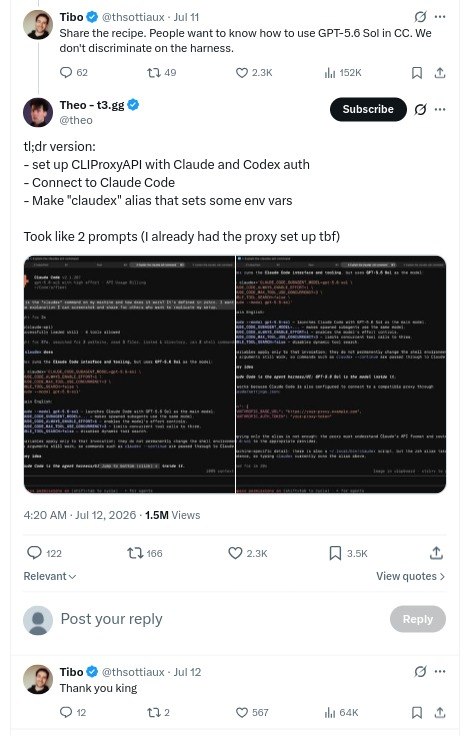
AI aprašymas Tai socialinio tinklo ekrano kopija, kurioje vartotojas dalijasi instrukcija, kaip per programinę priemonę „CLIProxyAPI“ prijungti „Claude Code“ prie „GPT-5.6“ modelio, pateikdamas terminalo langų su kodu pavyzdžius.
Sugeneravo dirbtinio intelekto modelis qwen3.8-27b-dk:latest (vienu ėjimu, be samprotavimo biudžeto). Žmogus netikrino.
DIA – tai savaitinis internetinis susitikimas verslinkams, profesionalams ir entuziastams, kurie automatizuoja procesus ir integruoja dirbtinį intelektą.